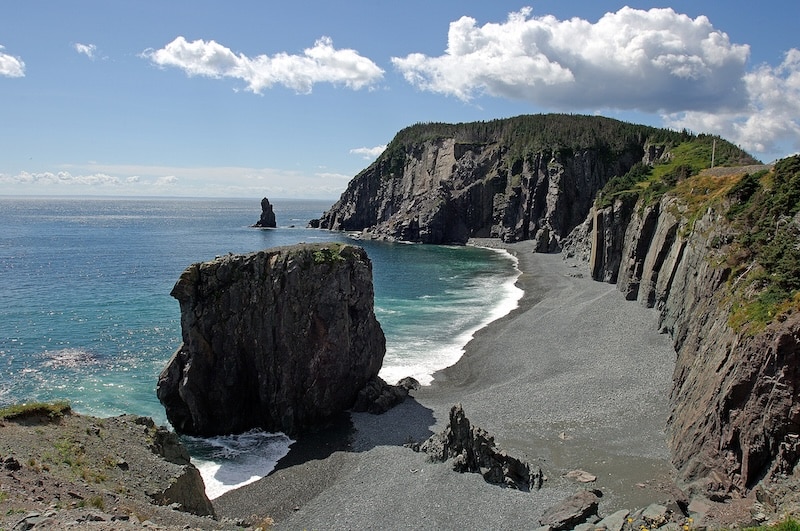

The hike from Signal Hill to the colourful Battery neighborhood in St. John’s, the capital of Newfoundland and Labrador.
The island of Newfoundland is the easternmost tip of North America, facing the vast expanse of the North Atlantic. Its draw is its rugged coastal beauty and pristine nature, complemented by its warm, welcoming culture and down-home quirky charm. You really do feel like you are going back in time to a simpler, friendlier, and down-to-earth place.

The Bonavista lighthouse at the tip of the Bonavista Peninsula on the east coast of the island of Newfoundland.
The remote island is comparable to Iceland in size and population yet attracts less than 15 percent of the number of tourists, making hiking in Newfoundland and Labrador wilder and less trodden — even in comparison to other popular Canadian hiking spots, such as Banff in Alberta and the Pacific Coast Trail in British Columbia.
There are three primary areas for hiking in Newfoundland: Bonavista in the northeast, the East Coast Trail along the eastern shore, and Gros Morne National Park in the west. Gros Morne is the go-to destination these days thanks to heavy marketing of its dramatic fjords, designated a UNESCO World Heritage site for its representation of continental drift.
But in true karibu adventures form, we knew that if that was where everyone else was going, we wanted to explore the road (or hike) less traveled.
Hiking Newfoundland’s Eastern Coast, we take the path less traveled
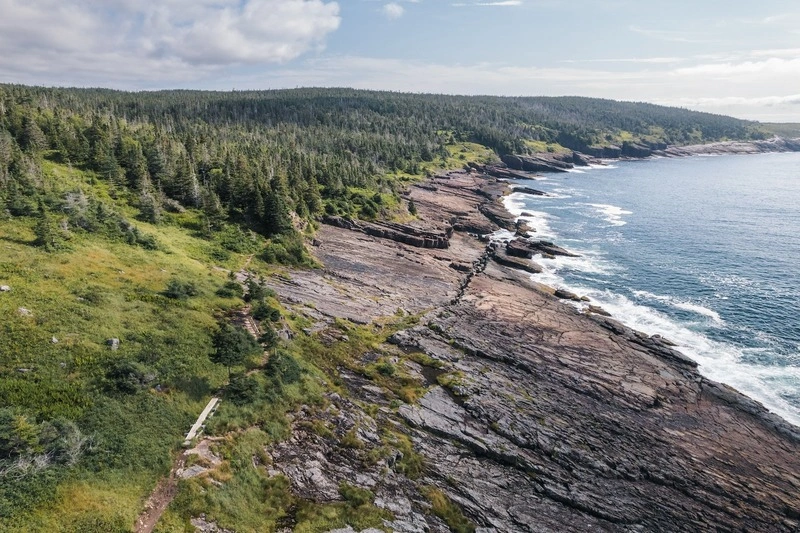
Newfoundland’s 336-kilometre East Coast Trail traces the southern shore of the Avalon Peninsula, awarding views of rugged forests and the severe North Atlantic Ocean.
Our hunt for our next Canadian tour destination brought us to the East Coast of Newfoundland, specifically the East Coast Trail, a hidden gem with spectacular coastal hiking and few people while still being easily accessible. Unlike Gros Morne, which requires additional flights (that are often cancelled due to weather) and is a 6.5-hour drive from the capital of St. John’s, the East Coast Trail begins right in the city and ends less than two hours south yet still feels a world away.
The East Coast Trail provides a more accessible and coastal-focused experience, while Gros Morne offers a more remote and mountainous adventure. (If you’re looking for very different mountainous hiking, you might prefer hiking northern Italy’s Alta Valsesia or Dominica’s volcanic mountains.)
Our new 8-day guided small group hiking tour of Newfoundland’s East Coast Trail and Bonavista is a one-of-a-kind deep dive into the Canadian province’s spectacular landscape and unique culture. We chase incredible scenery on our exploration of six of North America’s most scenic hikes. When we’re not hiking, we’re foraging, whale watching, and listening to traditional storytelling while still eating well and staying in comfortable, tasteful boutique accommodations.
Some of the best hiking in Canada is found on The East Coast Trail
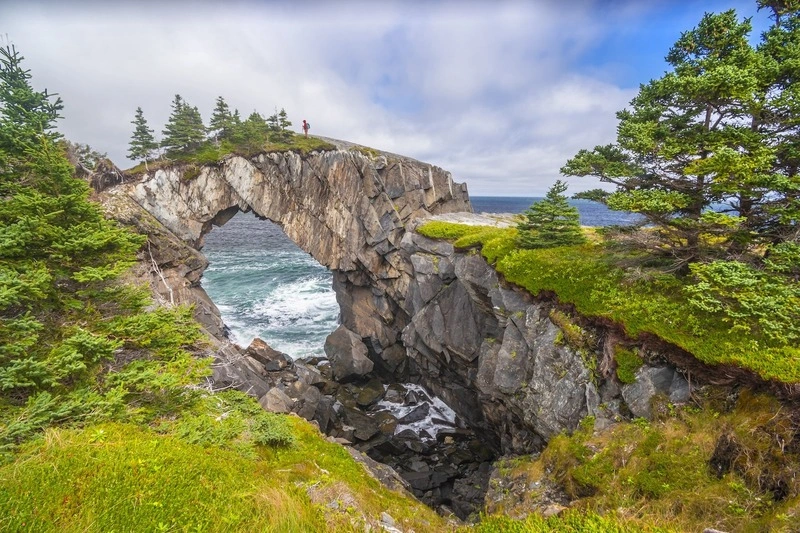
The Berry Head Sea Arch marks the midway point of the Spurwink Island Path segment of the East Coast Trail.
Named one of the best adventure destinations by National Geographic, the East Coast Trail is a long-distance coastal footpath on the Avalon Peninsula of Newfoundland’s east coast. The 336 kilometres of ever-changing boreal forest, dramatic shorelines, and crashing seascapes make up North America’s easternmost hiking path. Beginning in Conception Bay, the trail winds past lighthouses, natural arches, ecological reserves, and communities along Newfoundland’s southern shore to Cappahayden — a great viewpoint for seeing whales and seabirds. Founded and maintained by the volunteer-run East Coast Trail Association, the trail is also a testament to community and commitment to nature.
The East Coast Trail network has endless route options. It is broken down into 26 linked segments, offering a diverse range of hiking experiences, from short day hikes to multi-day treks, and unmatched highlights to discover on nearly every path. Just keep in mind that the paths are segments, not loops, which means you will need to retrace your route back to your starting point or arrange to be picked up at the other end.
The East Coast Trail’s Spout Hike Geyser
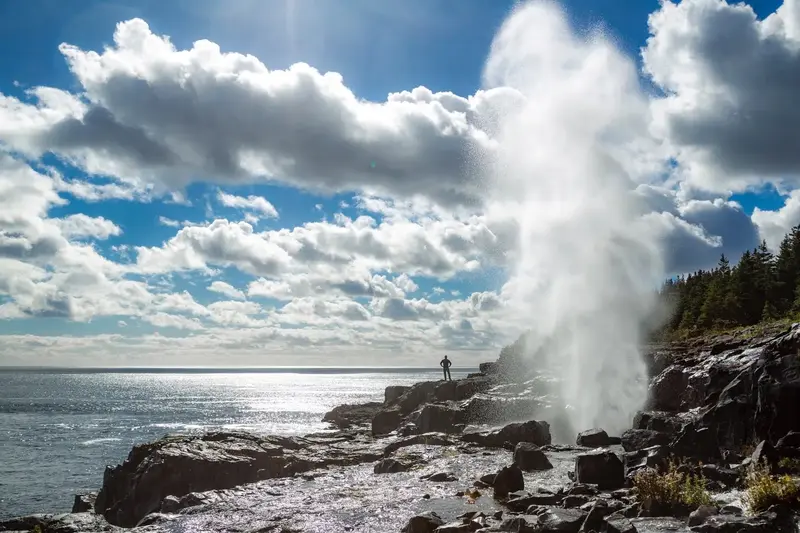
The namesake of this popular trail, The Spout, consistently spouts many metres into the air.
Distance: 16.2 km
Duration: 6–9 hours
Difficulty: Challenging
One of the most-loved paths along the East Coast Trail is the Spout Path, and it’s easy to see why. The Spout Path’s main attraction — a wave-powered geyser nicknamed ‘The Spout’ — is a dramatic display of water jetting nine metres into the air. But that’s not all. The 16.2-kilometre Spout Hike near St. John’s, the provincial capital, runs from Shoal Bay to Bay Bulls, past some of the most memorable coastal scenery in all of Newfoundland. It’s known for scenic vistas of steep cliffs plunging into the ocean and sea stacks rising out of the mist. Along the way, you can visit a functioning historic lighthouse and five waterfalls, and you’re likely to spot bald eagles and other seabirds. These highlights reward those who take up the challenge of one of the ECT’s most rigorous hikes.
Flamber Head Path

The Flamber Head Path’s 50-metre suspension bridge offers picturesque ocean views on one side and a towering cliffside on the other.
Distance: 11.5 km
Duration: 5–8 hours
Difficulty: Moderate to challenging
The Flamber Head Path is a favourite East Coast Trail segment that karibu includes in its hiking experience. The trail passes through changing landscapes and hike highlights, including a 50-metre suspension bridge beside a stunning rock face and raging waterfall that are part of the La Manche Provincial Park. The path makes its way to the top of a cliffside and the ruins of the small fishing village of La Manche, abandoned after a tragic storm sealed the fate of the already crumbling village. The landscape includes forests of balsam fir trees, wild Labrador tea, and lily ponds. Be on the lookout for moose, eagles, otters, and whales along the way.
Mickeleens Path and East Coast Trail’s Witless Bay wildlife

When traversing Mickleens Path, you’re likely to spot some of the hundreds of thousands of Atlantic puffins living on the coast of Newfoundland and Labrador.
Distance: 7.2 km
Duration: 2–4 hours
Difficulty: Easy to moderate
About 30 kilometres from the capital of St. John’s, Mickeleens Path is our recommended Newfoundland hiking trail for wildlife enthusiasts. The serene and scenic path takes you through woods and meadows, with ocean views of sea stacks and the Witless Bay Ecological Reserve. This easy 7.2-kilometre path along Newfoundland’s southern shore begins at Bay Bulls and ends at the East Coast Trail’s Witless Bay. There, you can see whales, puffins, and other seabirds in their natural habitat at the Witless Bay Seabird Ecological Reserve. The reserve consists of four seabird colonies, which breed on four islands in the surrounding waters. These islands provide breeding habitats for hundreds of thousands of seabirds. It has North America’s largest Atlantic Puffin colony and the world’s second-largest Leach’s Storm Petrel colony. On the karibu tour, you take an up-close look on a private boat tour into the Witless Bay Ecology Reserve.
Enjoy culture and coastal hiking in Bonavista, Newfoundland
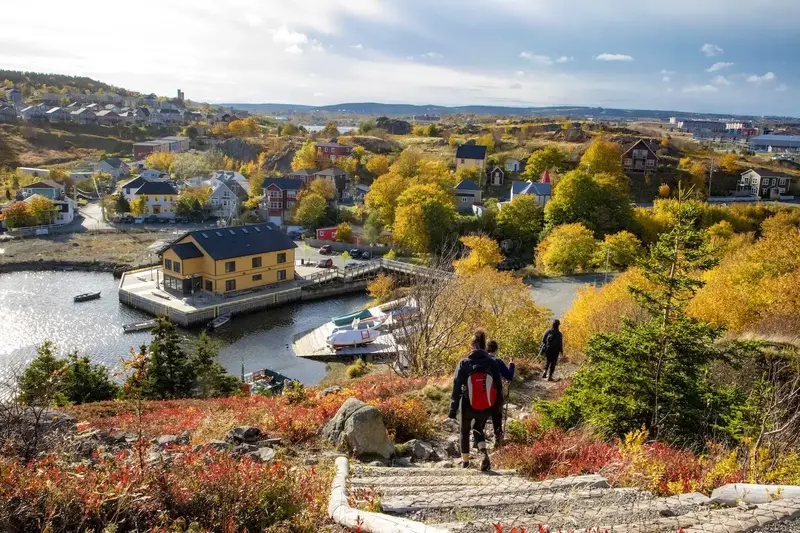
The quaint village of Trinity is a classic Newfoundland fishing village with colourful clapboard houses along Trinity Bay on the Bonavista Peninsula.
North of the St. John’s area and the Avalon is the scenic Bonavista Peninsula, known for its historic fishing villages and rugged, wave-eroded coastline. The eastern side of Bonavista is a UNESCO Global Geopark — a mecca for rock buffs made up of vast tracts of ancient granite. It boasts fossils and geological formations not found anywhere else, even underwater; divers flock to the Dungeon Sea Caves. The area is also a popular destination for whale watching.
In addition to its natural wonders, Bonavista stands out for its rich cultural heritage. The region is centred around the Town of Trinity, which began as a fishing community and evolved into an important centre for trade in the province. Its natural headland, Fort Point, also made it a defensive location against the French and American privateers. Today, many structures have been preserved to show the architectural and cultural heritage of the area. On our tour, we visit the village of New Bonaventure to explore outport communities by boat with a local fisherman, who shares his family’s story of life in these communities and takes us to his grandfather’s 100-year-old fishing stage.
Bonavista is smaller than the East Coast Trail, making it easier to take shorter hikes while not missing out on many attractions.
Bonavista’s Ireland dupe — Spillars Cove
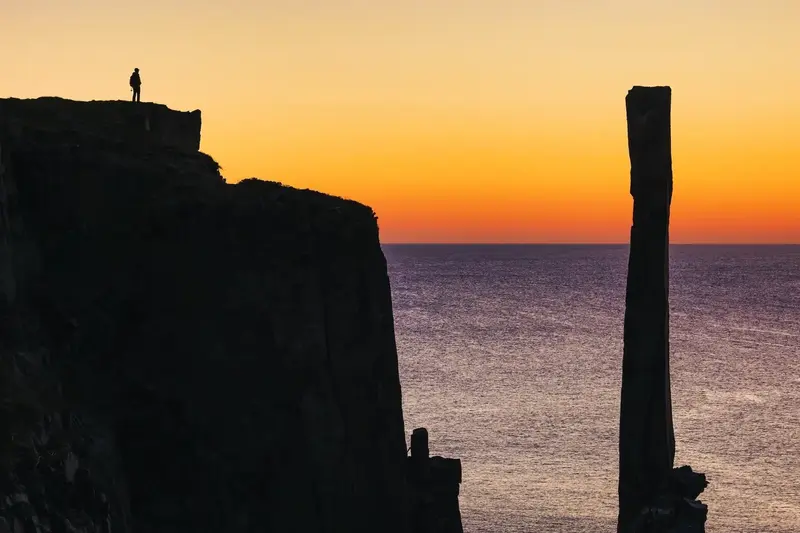
The Spillars Cove trail’s most photographed spot is the Chimney sea stack, part of the Discovery UNESCO Global Geopark.
Distance: 3.4 km
Duration: 1 hour
Difficulty: Easy to moderate
Not far from Bonavista village, the Spillars Cove Trail is a fun, easy, and quick hike with great views — especially of The Chimney, a narrow sea stack that’s a favourite seabird nesting site. The rocky bay and rugged cliffs, shaped by years of erosion, evoke the dramatic scenery of the rugged Irish coast.

Spillars Cove is known for its towering cliffs, which overlook the unique black sand on the beach below.
In May and June, Spillars Cove is the best place in North America to see icebergs. Bonavista is part of Iceberg Alley, a region known for sighting the translucent blue wonders. This trail is only 3.4 kilometres out and back, but the experience is meant to be savoured: in temperate months, it’s a popular place for birding, and in winter, it’s great for snowshoeing.
Skerwink Trail, one of Newfoundland’s most famous hikes
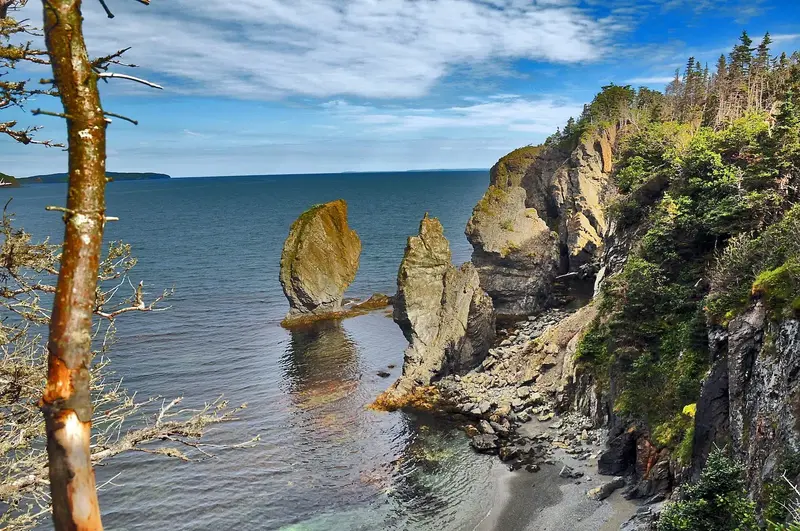
Views along the Skerwink Trail include craggy outcrops and wildlife, especially whales.
Distance: 5.3 km loop
Duration: about 1 hour
Difficulty: Moderate to challenging
The Skerwink Trail is internationally acclaimed for good reason. The 5.3-kilometre loop guides you along the coast of Skerwink Head, a rocky peninsula separating Trinity’s harbour from Port Rexton’s. Though it may be short, you can spend many hours soaking in the breathtaking cliffs along the dramatic coastline. It features views of famous sea stacks — with names like “Music Box” and “Flat Fish” — and overlooks the charming, colourful villages of Port Rexton and Trinity. You may be able to spot whales, like humpback, minke, fin, sperm, and many others, cresting in the ocean in June and July. You’ll share this popular area with fellow hikers, runners, and walkers.